
Summary
Western Canada’s chemical industry — spanning refineries, petrochemical complexes, fertilizer plants, and processing facilities — operates in one of the most demanding fall protection environments in the country. Workers face extreme elevation, hazardous atmospheres, and corrosive conditions across distillation columns, tank farms, flare stacks, and loading racks. Provincial OHS legislation and ANSI/CSA standards demand a rigorous, engineering-first approach. Tritech partners with chemical facilities across Western Canada through a 10-step turnkey process covering hazard assessment, in-house engineering, installation, certification, training, and annual recertification — all under one roof and one point of accountability.
Western Canada’s chemical industry is home to some of the continent’s most complex industrial environments. From Alberta’s Industrial Heartland to the Joffre petrochemical complex and refining corridors near Edmonton, Fort Saskatchewan, and Lloydminster, workers routinely access distillation columns, reactor vessels, pipe racks, storage tanks, and flare stacks where falls from height represent a persistent and potentially fatal hazard.
At Tritech Fall Protection, we engineer, design, supply, and install regulatory-compliant fall protection systems for chemical facilities across Western Canada. This resource is for EHS professionals, safety managers, turnaround coordinators, and facility operators who need to understand their compliance obligations and implement engineered solutions built for the unique demands of the chemical processing environment.
fatalities involve falls
violation: fall protection
engineered solutions
The Challenge: High Stakes at Every Elevation
Chemical facilities present a multi-layered web of fall hazards that interact with process safety, confined space, hot work, and hazardous atmosphere requirements. Unlike a standard commercial rooftop or warehouse mezzanine, a petrochemical plant demands fall protection solutions that account for extreme elevation, corrosive environments, temperature swings from −40°C to +35°C, and the time pressure of planned turnarounds where shortcuts become tempting.
Understanding where falls happen in chemical facilities is the first step toward eliminating them.
Pipe Racks and Pipe Bridges
Kilometres of elevated piping require ongoing inspection, valve maintenance, and instrument calibration. Workers access these structures via fixed ladders — often at heights exceeding 30 metres — in conditions exposed to wind, ice, and extreme temperatures.
Distillation Columns and Reactor Vessels
Vertical process towers can reach 60 metres or more. Turnarounds and emergency shutdowns require workers at every level — accessing platforms, manways, and instrumentation under time pressure that increases the risk of shortcuts.
Storage Tanks and Tank Farms
Tank top access for gauging, sampling, inspection, and maintenance exposes workers to unprotected leading edges and fall distances that are frequently fatal. Tank farms often lack permanent fall protection infrastructure, forcing reliance on ad-hoc measures during each access event.
Flare Stacks and Cooling Towers
These structures require periodic inspection and maintenance at extreme heights in fully exposed conditions. Wind loads compound fall risk significantly beyond what standard elevated work demands.
Loading Racks and Railcar Access
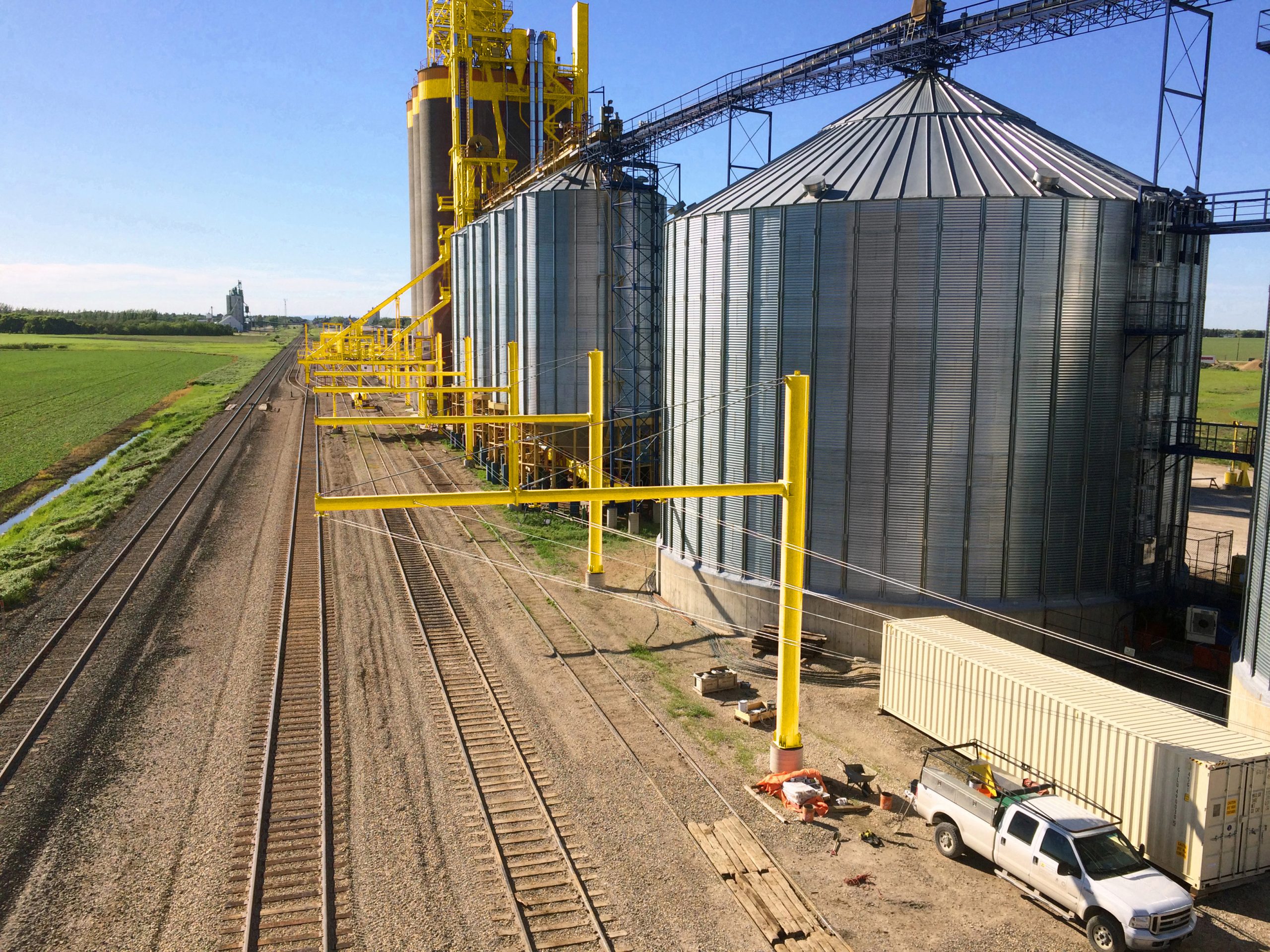
Chemical loading operations require overhead fall protection systems that allow workers to move freely across multiple loading positions while remaining continuously connected — transferring hazardous materials to and from railcars and tanker trucks.
“When a facility sources its hazard assessment from one vendor, its engineering from another, its equipment from a third, and its installation from a fourth, no single entity bears accountability for the integrity of the complete system.”
The hidden cost of fragmented fall protection procurement
The Regulatory Landscape
Chemical facilities in Western Canada operate under overlapping regulatory frameworks. Understanding the full scope of applicable standards is critical — particularly where fall protection intersects with Process Safety Management requirements unique to the chemical sector.
| Standard | Chemical Industry Relevance |
|---|---|
| Alberta OHS Code, Part 9 | Mandates fall protection at 3 m general and 1.2 m at permanent work areas. Written fall protection plan required when workers are exposed to a fall of 3 m or more and guardrails are not in place. Applies to all chemical facility maintenance and operations. |
| ANSI/ASSP Z359 | Comprehensive program code requiring documented policies, defined competent and qualified person roles, hazard assessment protocols, rescue planning, and annual inspection mandates. Certification of all engineered systems by a qualified person is required. |
| CSA Z259 Series | Canadian equipment standards governing harness, lanyard, lifeline, and anchor design, testing, and certification. Governs all engineered fall protection systems specified and installed for Canadian facilities. |
| PSM / OSHA 1910.119 | Process Safety Management requirements intersect with fall protection during maintenance, turnarounds, and management of change procedures. A worker incapacitated in a hazardous atmosphere can trigger catastrophic secondary events — elevating the consequences of failure beyond the fall itself. |
Why Single-Source Liability Matters
Too often, facilities treat fall protection as a commodity — sourcing components from catalogues, hiring general contractors for installation, and hoping the pieces fit into a compliant system. This fragmented model creates dangerous gaps in accountability, quality, and documentation that often go undetected until an incident occurs.
Fragmented Vendors
Turnkey Partner
The Tritech Solution: Truly Turnkey, Truly Accountable
Tritech Fall Protection Systems has been delivering custom-engineered fall protection solutions across North America since 1993. Headquartered in Calgary and Orlando, with territory managers throughout Western Canada, Tritech is a full-service, vertically integrated fall protection partner that owns every aspect of the process — from initial conversation through decades of ongoing service.
Where competitors may offer one or two components of the fall protection lifecycle, Tritech delivers all ten steps with in-house expertise at every phase.
| Step | Phase | What Tritech Delivers |
|---|---|---|
| 01 | Hazard Assessment | Manufacturer-trained assessors perform comprehensive worksite analysis, identifying fall risks and compliance gaps. We look first to eliminate hazards — even when that means no sale. |
| 02 | Project Proposal | Custom proposals aligned to your work procedures, budget, and compliance requirements, designed within the Hierarchy of Fall Protection. |
| 03 | Project Management | A dedicated PM manages your project end-to-end, delivering on time and on budget, with urgency on any concerns. |
| 04 | In-House Engineering | Qualified persons engineer solutions using advanced structural modelling and analysis — not restricted to off-the-shelf products. Anchor points certified to withstand arrest forces of 2,700 lbs per worker. |
| 05 | Custom Design | Systems designed for ease of use, pass-through capability, and continuous connection — maximizing worker adoption and minimizing resistance. |
| 06 | Product Supply | We partner with industry-leading manufacturers, objectively comparing options to deliver the most effective solution for each application. |
| 07 | Professional Installation | Manufacturer-trained installers execute to rigorous quality standards, working around your schedule to minimize operational disruption. |
| 08 | System Certification | Rigorous testing ensures every system meets or exceeds OSHA, ANSI, CSA, and all applicable standards before workers rely on it. |
| 09 | Worker Training | On-site, hands-on training plus electronic resources for ongoing retraining and new hire onboarding. |
| 10 | Documentation & Service | Complete electronic documentation, annual inspection programs, and emergency mobilization when you need it. |
Engineered Solutions for Chemical Facility Hazards
Tritech’s portfolio directly addresses the fall hazards most common across Western Canada’s chemical processing sector.
Horizontal Lifeline Systems
Continuous overhead protection for loading rack operations, pipe rack maintenance, and tank top access — engineered to CSA Z259.13 with amplification loads calculated for each unique configuration. Allows workers to move freely while remaining securely attached.
Vertical Ladder Safety Systems
Replace outdated cages on fixed ladders accessing distillation columns, reactor vessels, and flare stacks — bringing facilities into compliance with current regulations and protecting workers at the critical ladder-to-platform transition point.
Guardrail and Barrier Systems
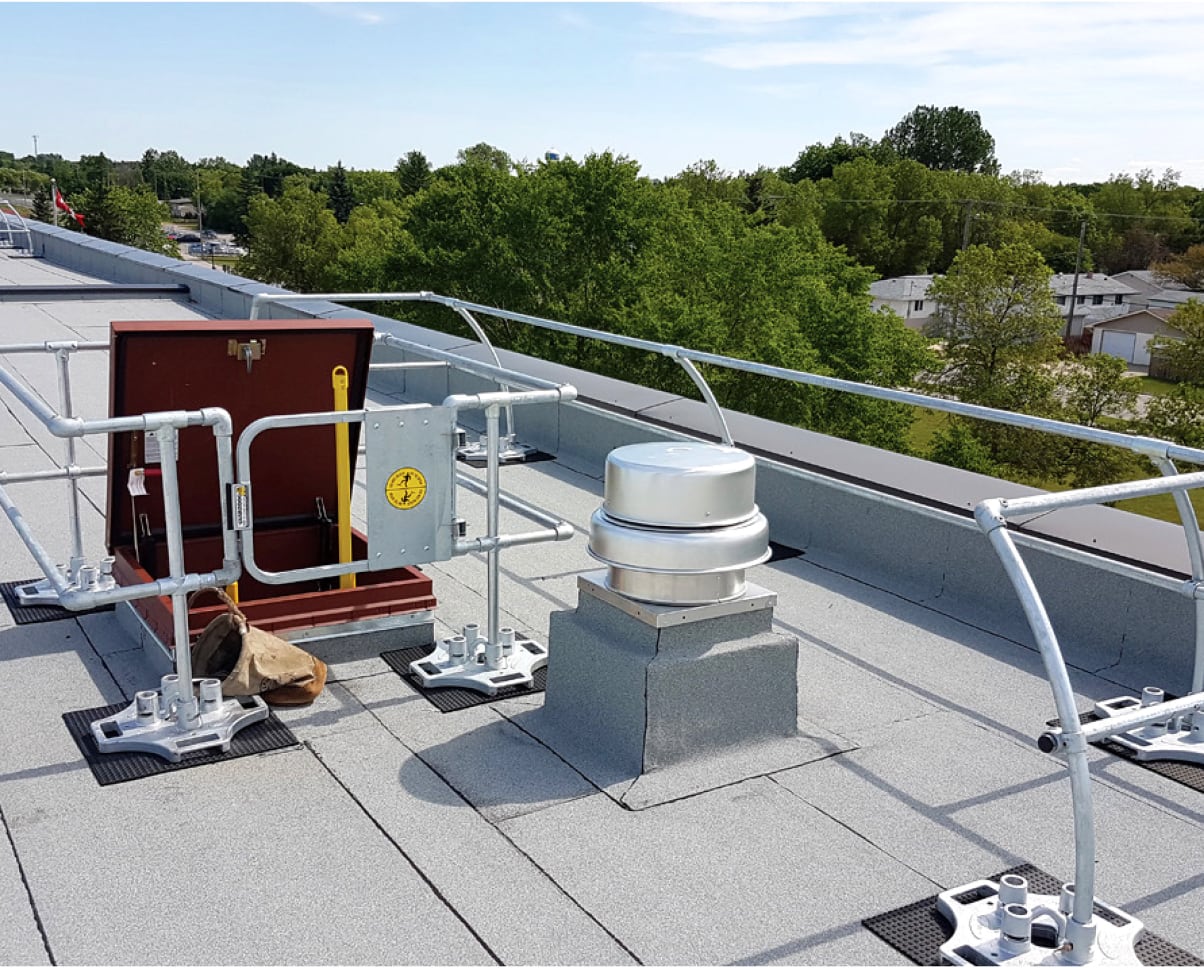
Custom-engineered passive protection at tank tops, mezzanines, and elevated walkways — with corrosion-resistant materials specified for chemical environments and non-penetrating ballasted options available where membrane integrity must be preserved.
Confined Space Entry & Rescue Systems
For reactor vessel manholes, storage tank entries, and process pit access — dual anchor points and work positioning capability addressing spaces where a simple fall arrest system is insufficient and hazardous atmospheres compound rescue complexity.
Measurable Outcomes
Chemical facilities that transition to a turnkey, single-source partnership consistently realize improvements across safety, compliance, operational efficiency, and total cost of ownership.
Unified Liability & Compliance
One partner, one accountability chain, one documentation system. Audit-ready records for every system across your facility, eliminating the compliance gaps that fragmented vendors create.
Reduced Fall Incident Rates
Custom-engineered systems designed for how your workers actually perform their tasks drive higher adoption rates and fewer near-misses.
Turnaround Efficiency
Pre-installed permanent systems and rapid-deployment temporary systems reduce rigging time during shutdowns, allowing maintenance crews to start productive work faster.
Lower Total Cost of Ownership
Consolidated vendor management and systems designed for longevity in corrosive chemical environments reduce the hidden costs that fragmented procurement creates.
Tritech offers Fall Hazard Assessment Services
Specifically designed to identify every fall exposure at your chemical facility and provide a clear, OHS-compliant remediation plan — without disrupting your ongoing operations or planned turnaround schedule. We also provide inspection and recertification services for existing systems, keeping your anchors, lifelines, and guardrails certified and your liability exposure minimized.
Ready to consolidate your fall protection under one roof?
Contact Tritech for a complimentary fall hazard assessment.
With over three decades of experience serving Western Canada’s refineries, petrochemical plants, and processing facilities, we deliver the engineering expertise and single-source accountability your operation demands.
TRITECHFALLPROTECTION.CA · CALGARY, ALBERTA · ENGINEERED FALL PROTECTION SINCE 1993