


TL;DR
Falls from heights remain one of the most persistent causes of workplace injury and death across Alberta, Saskatchewan, and Manitoba. From grain elevators and oil and gas facilities to manufacturing plants and construction sites, workers across the Prairie provinces face fall hazards that demand more than basic PPE — they require comprehensive, engineered solutions. Provincial OHS legislation in all three provinces mandates a hierarchy of controls that prioritizes engineered fall protection. Tritech partners with organizations across the Prairies through a turnkey approach covering hazard assessment, engineering, installation, training, and annual recertification.
Falls from heights are the leading cause of serious workplace injury and death across Canada’s Prairie provinces. In Alberta, Saskatchewan, and Manitoba, the combination of vast industrial landscapes, extreme weather conditions, and a workforce frequently operating at elevation creates a uniquely challenging safety environment.
At Tritech Fall Protection, we engineer, design, supply, and install regulatory-compliant fall protection systems across the Prairies and beyond. This resource is for EHS professionals, safety managers, facility operators, and contractors who need to understand their obligations and implement engineered solutions that protect workers — no matter the industry or jurisdiction.
The Challenge: A Region at Height
The Prairie provinces share a common economic foundation built on industries that inherently involve work at height. Agriculture, oil and gas extraction, mining, grain handling, utilities, construction, and manufacturing all require workers to operate on elevated platforms, rooftops, ladders, railcar loading systems, and confined spaces on a daily basis. The sheer geographic scale of these provinces means that worksites are often remote, spread across thousands of kilometres, and subject to temperature extremes that can make fall hazards even more dangerous.
The statistics paint a sobering picture across all three provinces:
Falls by the Numbers — Prairie Provinces
| Province | Key Fall Protection Statistics |
|---|---|
| Alberta | 203 workplace fatalities in 2024, the highest in over a decade and above the provincial average of approximately 165 per year. Falls from heights accounted for 19% of all workplace injuries. In 2024, there were 18 fatal fall-related incidents, representing approximately 9% of total workplace fatalities. |
| Saskatchewan | Slips, trips, and falls rank as the second-leading cause of serious workplace injuries. WorkSafe Saskatchewan’s Fatalities and Serious Injury Strategy identifies falls as accounting for 24% of all serious injuries, with an injury rate of approximately 4.33 fall-related injuries per 100 workers. |
| Manitoba | The Workers’ Compensation Board of Manitoba reports that 18% of workplace injuries result from falls — the third leading cause. In sectors such as healthcare, nearly 20% of all injuries reported to the WCB are fall-related. |
These numbers are not abstract. They represent workers — parents, partners, and colleagues — whose lives are permanently altered or ended by preventable incidents. Behind every statistic is a workplace that could have been made safer with proper engineering, planning, and investment in fall protection infrastructure.
The Regulatory Landscape
Each Prairie province maintains its own occupational health and safety legislation governing fall protection, though they share a common foundation. Understanding the nuances of each jurisdiction is critical for organizations operating across provincial boundaries — a common reality for many Prairie businesses.
Alberta
Alberta’s OHS Code, Part 9, sets the standard fall protection threshold at 3 metres (10 feet), with a lower threshold of 1.2 metres for permanent work areas. A written fall protection plan is mandatory whenever workers may fall 3 metres or more and guardrails are not in place. The code requires that personal fall arrest systems include a full-body harness, a lanyard with shock absorber or self-retracting lifeline, and secure anchor points capable of withstanding required arrest forces. Alberta’s framework is among the most detailed in Canada, reflecting the province’s heavy industrial activity.
Saskatchewan
Saskatchewan’s OHS Regulations require fall protection at the standard 3-metre threshold. The province places particular emphasis on employer responsibilities for hazard assessment and worker training. Given the prominence of agriculture and mining in the provincial economy, Saskatchewan has focused enforcement efforts on industries where workers frequently operate at elevation without adequate engineered controls.
Manitoba
Manitoba’s Workplace Safety and Health Regulation similarly mandates fall protection at 3 metres, with a notable 1.2-metre threshold for areas used as paths for wheelbarrows or similar equipment. Where guardrails are impractical, employers must implement travel restraint, fall arrest, safety nets, or another system approved by the Workplace Safety and Health Branch. Manitoba’s regulatory approach emphasizes the hierarchy of controls, prioritizing elimination and engineering solutions before relying on personal protective equipment.
Key Insight: All three provinces share a critical principle: fall protection goes beyond personal protective equipment. Regulations mandate a hierarchy of controls that prioritizes engineered solutions — guardrails, lifelines, and purpose-built access systems — over reliance on harnesses and lanyards alone.
Key Regulatory Standards Across the Prairie Provinces
Alberta OHS Code, Part 9 — Fall protection required at 3 m (general) and 1.2 m for permanent work areas; written fall protection plan mandatory
Saskatchewan OHS Regulations, Part VIII — Fall protection required at 3 m; emphasis on employer hazard assessment and worker training obligations
Manitoba Workplace Safety and Health Regulation — Fall protection at 3 m; 1.2 m threshold for wheeled equipment paths; hierarchy of controls mandated
CSA Z259 Series — Industry standard for fall arrest components, horizontal lifelines, anchor systems, and personal fall protection equipment across all provinces
ANSI Z359.2 — Minimum requirements for a comprehensive managed fall protection program; referenced in annual inspection and recertification obligations
Cross-Industry Fall Hazards in the Prairies
What makes the Prairie provinces unique is the diversity of industries that require robust fall protection programs. Unlike regions dominated by a single sector, the Prairies demand solutions that span agriculture, energy, manufacturing, transportation, and infrastructure maintenance — often within a single organization’s operations.
Agriculture and Grain Handling
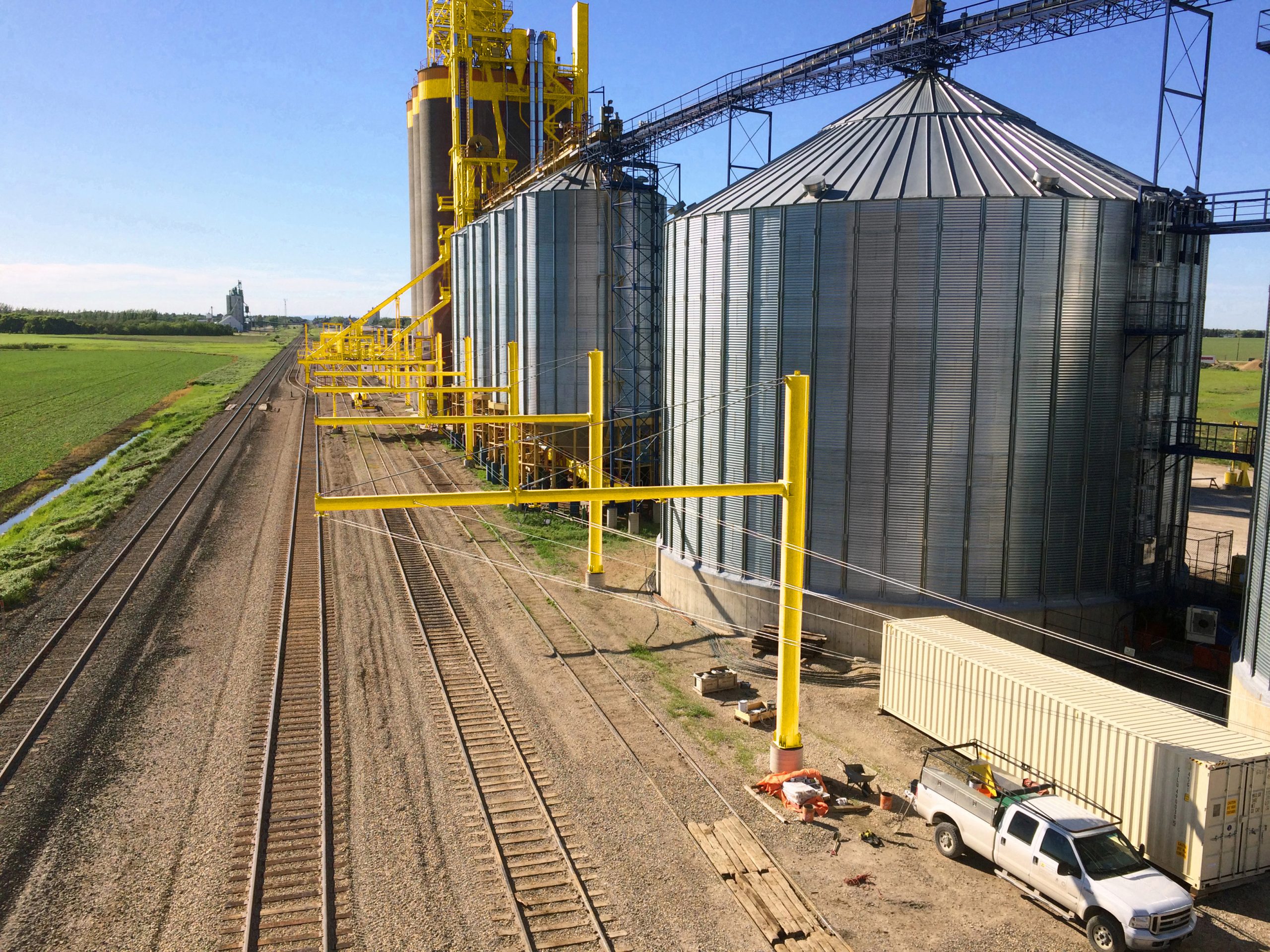
Workers routinely climb fixed ladders exceeding 24 feet to access bin tops, operate on rooftops for HVAC maintenance and grain spill cleanup, and enter confined spaces such as boot pits, distributors, and storage bins. Railcar and truck loading operations require overhead lifeline systems spanning hundreds of feet, with multi-track configurations common at larger grain terminals.
Oil, Gas, and Energy
Workers access elevated platforms on drilling rigs, service compressor stations, maintain pipeline infrastructure, and work on tanks at battery locations — all at significant height. Temperature swings from +35°C summers to −40°C winters add complexity, as equipment must perform reliably year-round and workers face increased risk from icy surfaces and reduced dexterity in cold conditions.
Manufacturing and Warehousing
Manufacturing facilities require fall protection for equipment maintenance at height, mezzanine access, conveyor system servicing, and rooftop unit maintenance. Warehousing operations face similar challenges with elevated storage systems and loading dock areas. These environments often involve multiple trades working simultaneously, requiring systems that accommodate varied work tasks and movement patterns.
Construction and Infrastructure
Rapid urban growth in Calgary, Edmonton, Saskatoon, Regina, and Winnipeg drives ongoing construction activity, while rural infrastructure projects — bridges, water treatment plants, and telecommunications towers — create additional demand for fall protection across all three provinces.
Falls from height are the leading cause of workplace death on Canadian construction sites — and fall protection is the most frequently cited OHS violation in every province. Behind every statistic is a workplace that could have been made safer.
The Solution: Engineered Fall Protection Programs
Addressing the Prairie provinces’ diverse fall protection challenges requires more than off-the-shelf equipment. It demands a programmatic approach rooted in engineering expertise, regulatory knowledge, and an understanding of how workers actually perform their tasks. This is where the distinction between simply purchasing safety equipment and implementing a comprehensive fall protection program becomes critical.
Going Beyond PPE
As outlined in the CSA Z259 standards, an effective fall protection program encompasses far more than providing workers with harnesses. It requires documented policies and procedures, clearly defined duties and responsibilities, ongoing training, thorough hazard assessment and mitigation, rescue planning, and incident investigation protocols.
Most personal protective equipment is user-worn, requires proper fit, and is otherwise passive. Fall protection is fundamentally different because it also requires proper anchorage — and anchorage is entirely dependent on location. A harness is only as effective as the anchor point it connects to, and that anchor point must be engineered to withstand the forces generated during a fall arrest, which can reach 2,700 pounds per worker or higher when horizontal lifeline amplification is considered.
The Tritech Approach
Tritech Fall Protection Systems has been engineering, designing, supplying, and installing regulatory compliant fall protection systems across North America since 1993. With its Calgary office serving as a hub for Prairie province operations, Tritech brings a turnkey methodology that addresses every phase of fall protection program development:
Tritech’s Turnkey Fall Protection Process
| Phase | Scope |
|---|---|
| Hazard Assessment | In-house engineers assess work processes, identify fall hazards, and evaluate existing infrastructure to determine the most effective mitigation strategy for each location. |
| Engineering & Design | Qualified persons design custom systems — guardrails, horizontal and vertical lifelines, platforms, gangways, and ladder safety systems — engineered to meet CSA standards and provincial OHS requirements with appropriate safety factors. |
| Installation | Manufacturer-trained installers execute the installation, ensuring that every anchor point, lifeline, and guardrail is properly secured and certified. |
| Training | Workers and supervisors receive training on proper use of installed systems, inspection procedures, and rescue planning. |
| Inspection & Recertification | Annual inspection programs ensure systems remain in compliance and continue to perform as designed, per CSA Z259 and ANSI Z359.2 requirements. |
Engineered Solutions for Common Prairie Hazards
Tritech’s product portfolio directly addresses the fall hazards most common across Prairie province industries:
Horizontal Lifeline Systems
Continuous overhead protection for railcar loading operations, conveyor access, and rooftop maintenance — allowing workers to move freely while remaining securely attached. Engineered to CSA Z259.13 and designed around the structural members of each specific facility.
Vertical Ladder Safety Systems
Replace outdated cages on fixed ladders, bringing facilities into compliance with current regulations. Protect workers throughout the full climb and reduce exposure at the critical ladder-to-platform transition point.
Guardrail and Barrier Systems
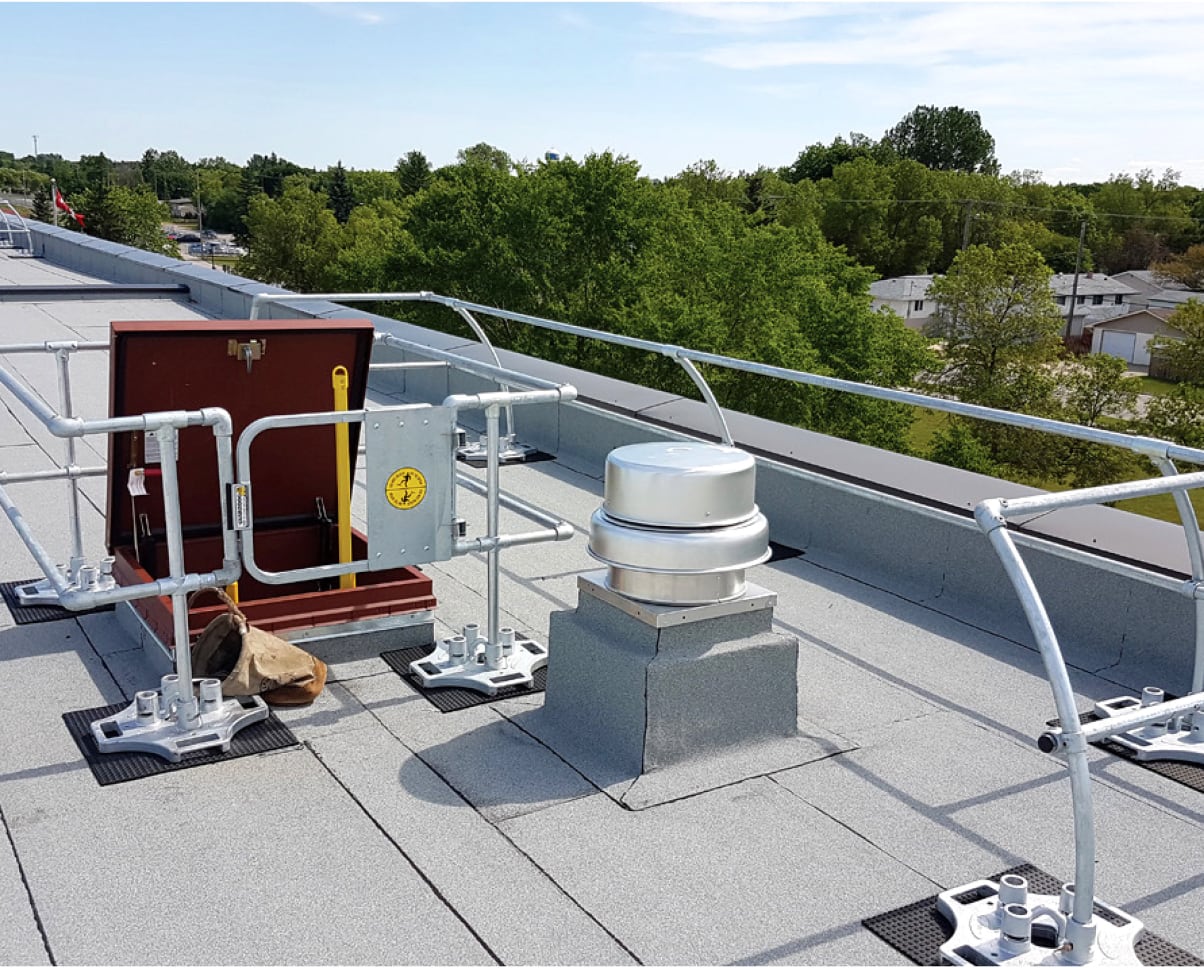
Custom-engineered platform and gangway systems provide stable, non-slip access to elevated work areas, while guardrail and barrier systems create passive protection at leading edges, mezzanines, and rooftops — with non-penetrating ballasted options available for membrane-sensitive roofs.
Confined Space Entry & Rescue Systems
For boot pits, grain bins, distributors, and dust collection systems, Tritech designs entry and rescue systems with dual anchor points and work positioning capability — addressing the unique requirements of spaces where a simple fall arrest system is insufficient.
Results and Impact
Organizations across the Prairie provinces that invest in comprehensive, engineered fall protection programs consistently report measurable improvements across several dimensions:
Tritech offers Fall Hazard Assessment Services specifically designed to identify every fall exposure at your Prairie province facility and provide a clear, OHS-compliant remediation plan — without disrupting your ongoing operations.
We also provide inspection and recertification services for existing systems — critical for any facility where guardrails, anchors, or lifelines were installed under previous ownership or following significant structural changes. Annual inspections keep your systems certified and your liability exposure minimized.
Ready to Strengthen Your Fall Protection Program?
Contact Tritech Fall Protection to schedule a complimentary hazard assessment. With over three decades of experience serving Alberta, Saskatchewan, and Manitoba, we deliver the expertise needed to make every workplace safer.
tritechfallprotection.ca · Calgary, Alberta · Engineered Fall Protection Since 1993


